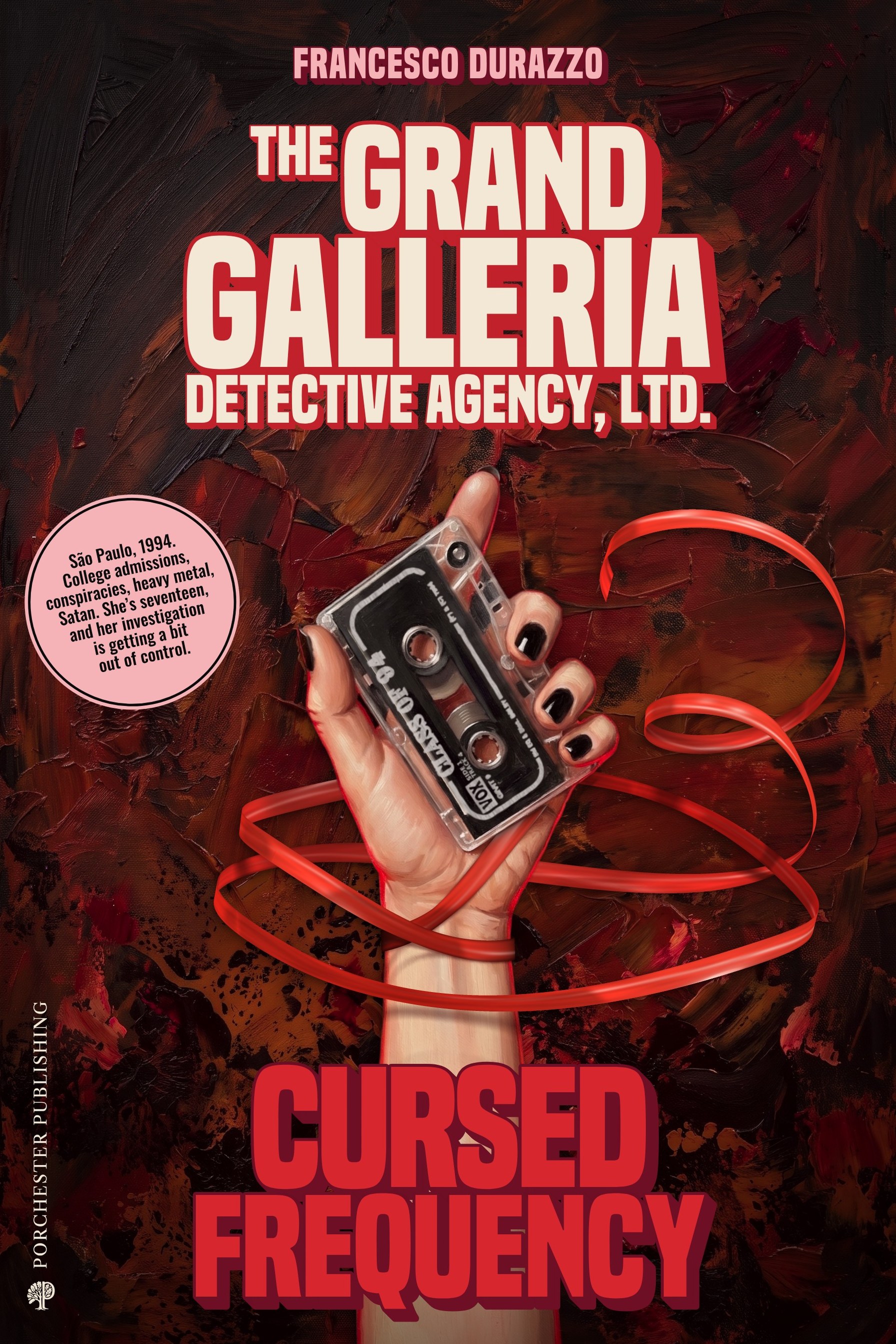
The Grand Galleria Detective Agency, Ltd.
Cursed Frequency
São Paulo, 1994. College admissions, conspiracies, heavy metal, Satan. She’s seventeen, and her investigation is getting a bit out of control.
Coming soon
Reserve your copyThe book
São Paulo, October 1994. Two years after impeaching a president, Brazil buried Senna, won the World Cup, and changed its currency. Prices stopped going up, for now.
Odete is seventeen, has a black trench coat, and is scared she’ll fail the harsh entrance exam for her chosen university. She’s lived with her grandmother since her parents moved to a gated community outside the city without her. In the afternoons she minds her uncle’s rubber-stamp shop in a building officially called the Grand Galleria and known to everyone as the Rock Galleria, where São Paulo’s underground scene buys records, kills time, and turns every rumor into a conspiracy theory. Customers hardly ever show up, so she has time for what she does best: sticking her nose where it doesn’t belong and tracking every story to its source.
When the leader of a hardcore band shows up complaining that his demo tape has been tampered with, Odete decides to investigate. As the case gets hairier, she recruits a handful of people from the scene to chase it down: friends with more free time than qualifications, and a girl who complicates everything.
As the story gets out, the press blames the devil, extraterrestrials, a real-estate scam, or mass hysteria. A pastor goes on TV to call the building the maternity ward of the Apocalypse, and anyone who listens to metal, punk, or goth rock becomes a suspect.
With exams coming up and her family telling her to drop everything, Odete has to choose between the future expected of her and a mystery that was never any of her business.
Book 1 of The Underqualified Trilogy.
Mystery · Humor · The ’90s
Excerpt
⸤GRAND GALLERIA, 4TH FLOOR · FRI OCT 07 1994 · 2:00 PM⸥
According to the fourth floor, somebody threw a guy down the light well. According to the third, he hung on by one arm before he fell. The second floor said it was a fight between punks and metalheads. According to the first floor, it was over some skirt.
According to the basement, it was a kid of about fifteen with a skateboard and a terrible idea.
The light well was an oval hole that ran through the entire building, from the roof to the basement: five floors of open air with a railing set too low. Odete only found out the basement's version because she went down there to ask.
It was almost two in the afternoon, and the rubber-stamp shop had not seen a single customer since she raised the grate. This was not unusual. Odete suspected that the shop existed not to sell stamps but to justify the bills on a space where its owner, Uncle Osmar, her father's younger brother, could keep the junk he no longer wanted at home. She was there because she needed an afternoon job that did not demand constant attention. Uncle Osmar needed someone to hold down the counter while he got up to his shenanigans somewhere else.
The arrangement worked. She studied for the FUVEST (the entrance exam that alone decided who got into the University of São Paulo), he disappeared, the stamps gathered dust, and everyone pretended this was a great endeavor.
Mazzini showed up a little after two, the way he showed up every afternoon when business downstairs began to slow toward the end of the day. He worked at the record store on the second floor, one of the good ones, but he came up to the fourth floor to take a breather away from his boss.
"Has the Stamp King shown up yet?"
"Not yet," Odete said.
"Typical. Kings make their own schedule."
He unwrapped a black Halls candy. "Did you hear? Somebody threw a guy down the light well."
"Threw a dude?"
"Yep, threw a fella. He hung from the railing, screaming, until he let go and the fella fell all the way down. Blood everywhere."
Odete looked at him. Mazzini was in his early forties and knew more about music than anyone she knew. He also believed any story, as long as it was dramatic enough.
"Who told you?"
"A kid from the third floor. Who heard it from a guy. Who heard it from a girl who works at the salon downstairs."
"And did this girl see it?"
"She heard the scream."
"And the body? Did anybody see the blood everywhere?"
Mazzini frowned. He had not thought to check. The story was worth more than the truth. "Somebody must have. I don't know. Why, you think it's a lie?"
"I don't know, but I'm going to find out."
About the author
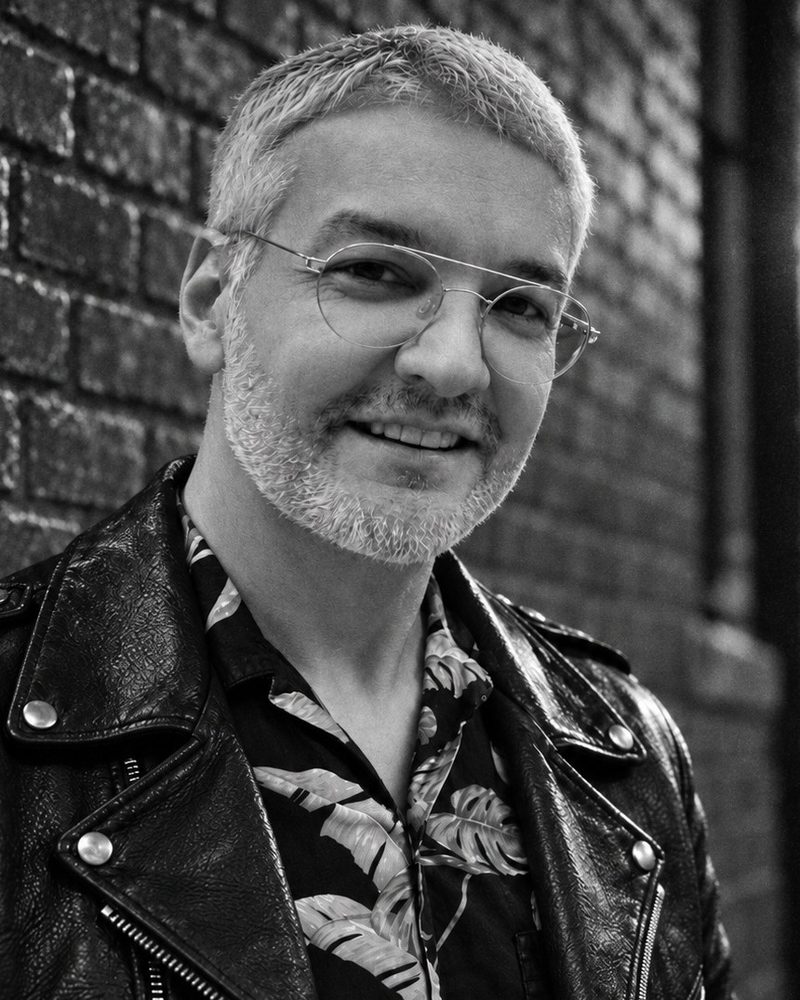
Francesco Durazzo is a journalist and a technologist. Born in São Paulo in the late ’70s, he was about the age of his first novel’s protagonist in 1994 and hung out in the same places as its characters. He was a fairly active figure in the city’s underground scene, as a fanzine editor, the organizer of a writers’ collective, and a contributor to all sorts of publications. Shortly after that period, he moved to the United States, then to the United Kingdom. That’s why this book is as much the building of a mystery as an exercise in nostalgia.
Get the book
Out in December 2026 in English and Portuguese, as an ebook, paperback, and hardcover. Store links go here once the book is on sale.
- Amazon
- Apple Books
- Kobo
- Google Play Books
- Clube de Autores
Contact
Email: [email protected]